Sign up here
If you want to become part of KNOCA’s community and receive our regular newsletter and details of upcoming events please click on ‘Sign up’.
Sign up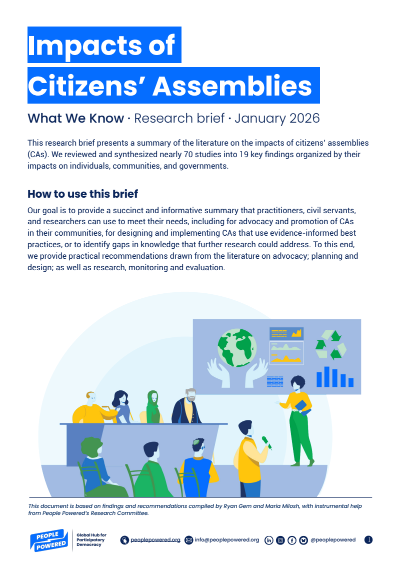
People Powered, the global hub for participatory democracy, has reviewed 70 studies and synthesising the research into 19 key findings to help understanding, advocacy and implementation of citizens’ assemblies. As a relatively recent innovation in participatory democracy, the full breadth of impacts of citizens’ assemblies are still emerging. Key findings include:
As People Powered note, much of the academic literature on assemblies is inaccessible, either locked behind paywalls or presented in dense academic language. Plus, most practitioners in government and civil society simply do not have the time to sift through dozens of studies to find information relevant to their needs.
People Powered has also produced an interactive Air Table so anyone can review and reanalyse the data on which the report is based.
Download the report here.

The Knowledge Network on Climate Assemblies (KNOCA) aims to improve the commissioning, design, implementation and impact of climate assemblies, using evidence, knowledge exchange and dialogue. We are an active community of policy makers, practitioners, activists, researchers and other actors with experience and interest in climate assemblies who co-create activities and knowledge.
